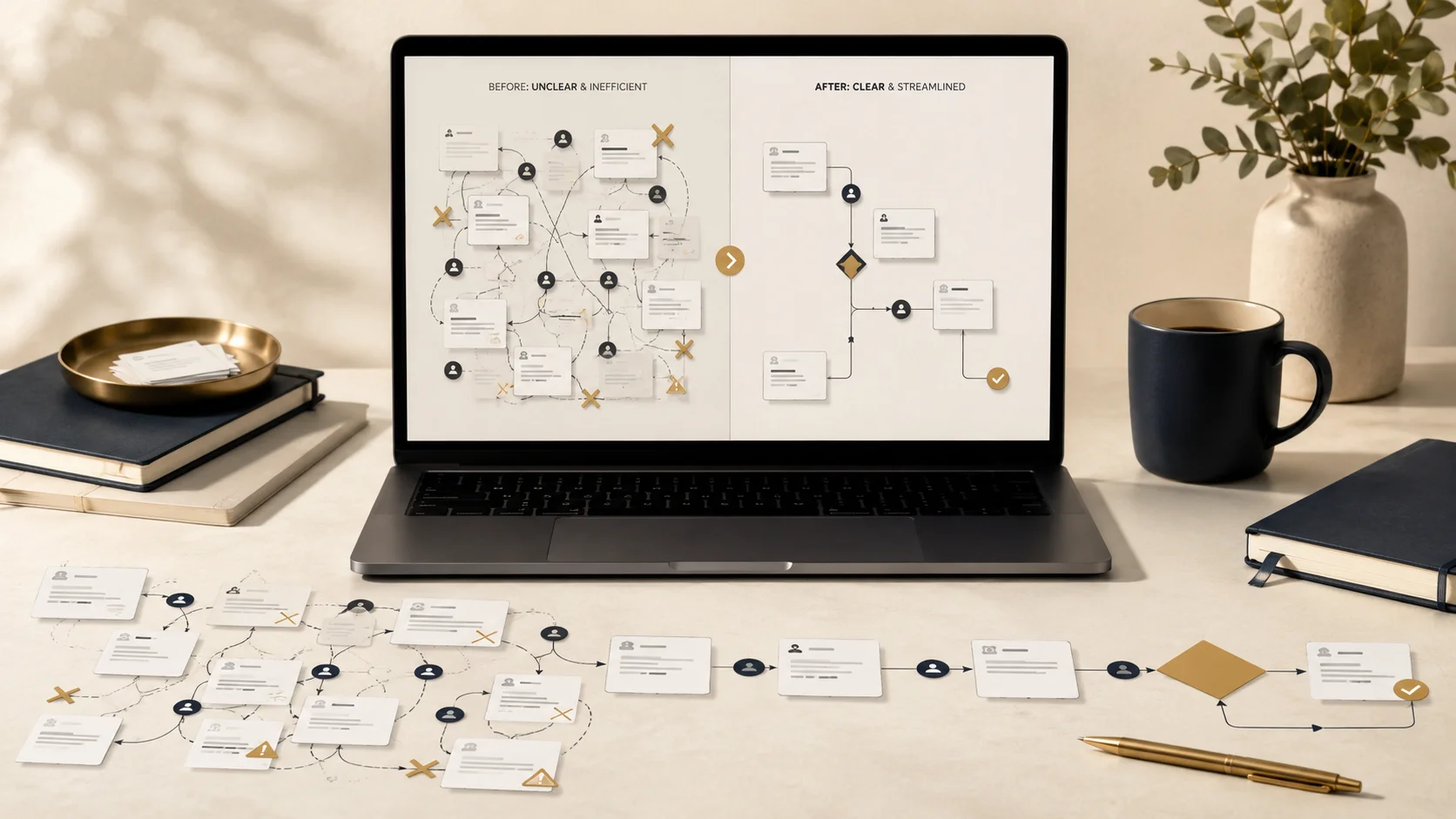
A copyright report, client disagreement, copied post, or licensing dispute often triggers the same rushed search: original files, early drafts, publication links, contracts, messages, invoices, and dates scattered across several systems.
That is the weakest point to reconstruct an ownership history. Records created before a dispute give the asset a clearer timeline and reduce the number of facts that depend on memory.
Proof of ownership should not be treated as one certificate or one timestamp. A useful record connects the defined asset, claimed owner, source material, creation history, ownership basis, publication history, licensing terms, file integrity, and material needed to answer a challenge.
Start with one clearly defined asset
An ownership record loses value when it refers to a broad category such as “my artwork,” “our content,” or “the brand.” The record should identify the exact work, release, file set, character, product, or client delivery being documented.
The basic asset record should state:
- The asset title and category.
- The claimed owner or rights holder.
- The original creation date being declared.
- The ownership basis.
- The first publication details, when applicable.
- The current licensing or commercial-use status.
- The original file or defined source-file set connected to the record.
One defined asset may be a photograph, article, track, video, digital character, logo, software release, template, 3D model, illustration, or mixed-media work. A collection can be treated as one asset only when its boundaries are clear and the files belong to one documented release or body of work.
Source integrity: retain the material behind the final export
A final JPEG, MP4, PDF, audio file, or published page shows the finished result. It may reveal little about how the work was produced or who controlled the working material.
Stronger source evidence may include:
- Original camera files, project files, raw audio, source code, or editable design files.
- Working prompts, generation settings, seeds, reference material, and selected outputs for AI-assisted work.
- Drafts, sketches, outlines, test renders, alternate edits, and rejected versions.
- Embedded metadata and application history that remain connected to the source.
- Backups stored separately from the device used to create the work.
The objective is not to keep every disposable file. The objective is to retain enough original material to show a credible path from early work to the released asset.
Creation dates need supporting records
A date typed into a certificate is a declaration. The surrounding records determine how well that date can be supported.
Useful timeline evidence can include dated drafts, cloud-storage history, repository commits, export records, messages sent during production, client feedback, invoices, publication logs, and archived URLs.
Two Different Dates
Keep the original creation date separate from the issue timestamp. The first describes when the work was created. The second records when the ownership documentation was issued.
This distinction is central for older assets. A record created today cannot turn a declared date from several years ago into a contemporaneous timestamp. It can organize the claim and connect it to earlier evidence that already exists.
Version history should show how the work developed
Version history helps connect the finished asset to the working process. It can show progression, repeated control over the files, and the point at which a draft became a published or delivered work.
A practical version record can contain:
- Early material. Sketches, rough cuts, draft text, test images, prototypes, or first commits.
- Meaningful revisions. Files that record major changes in composition, structure, functionality, or content.
- Approval points. Client comments, internal review, selected versions, or delivery messages.
- Final output. The exact file or release treated as the completed asset.
- Later adaptations. Crops, translations, platform formats, updates, remixes, or licensed versions derived from the original.
Renaming copies as final-1, final-2, and final-final does not create a useful record on its own. Files need dates, context, and a clear relationship to the finished work.
Ownership basis should explain why the claimant holds the rights
“I have the file” and “I own the rights” are different statements. The record should identify the basis of the ownership claim.
Original creator
The claimant created the work and retained the relevant rights.
Commission or client work
A written agreement states which rights were assigned, licensed, or retained.
Assignment or acquisition
A signed transfer or purchase record connects the prior owner to the current owner.
Collaborative work
Contributor records identify roles, permissions, payment, credit, and the treatment of shared rights.
AI-assisted assets may need an extra layer of documentation. Record the tools, source inputs, human contribution, editing process, relevant licenses, and any third-party material used. The presence of an AI tool does not answer who owns every element or which rights can be transferred.
Publication records should identify the first public release
Publication evidence connects the asset to a public date, account, URL, platform, and presentation. It can help distinguish the first release from later reposts or adaptations.
Keep:
- The first publication URL and date.
- The publishing account, domain, channel, or storefront.
- A screenshot showing the work and surrounding page context.
- Archived versions or platform records when available.
- Later publication, syndication, licensing, and campaign links.
- Takedown notices, claims, or correspondence connected to unauthorized use.
A screenshot without a URL or date can be difficult to place. A URL alone may disappear. Keep both the live reference and a local record.
Licensing records should separate ownership from permission
An owner can license an asset without transferring ownership. A client can receive broad commercial rights without receiving every right. A collaborator can contribute work without becoming the sole owner.
The evidence trail should record:
- Who granted the permission.
- Who received it.
- The exact asset covered.
- The permitted uses, platforms, territories, formats, and duration.
- Whether the permission is exclusive or non-exclusive.
- Payment, attribution, modification, sublicensing, and termination terms.
- Any rights retained by the creator, client, studio, or contributor.
Current licensing status belongs in the asset record. A dispute can concern unauthorized use rather than authorship, and the relevant question may be whether permission existed for that use.
A file fingerprint should identify the exact file
A SHA-256 fingerprint is a long value calculated from a file’s contents. The same file produces the same value. A changed file produces a different value.
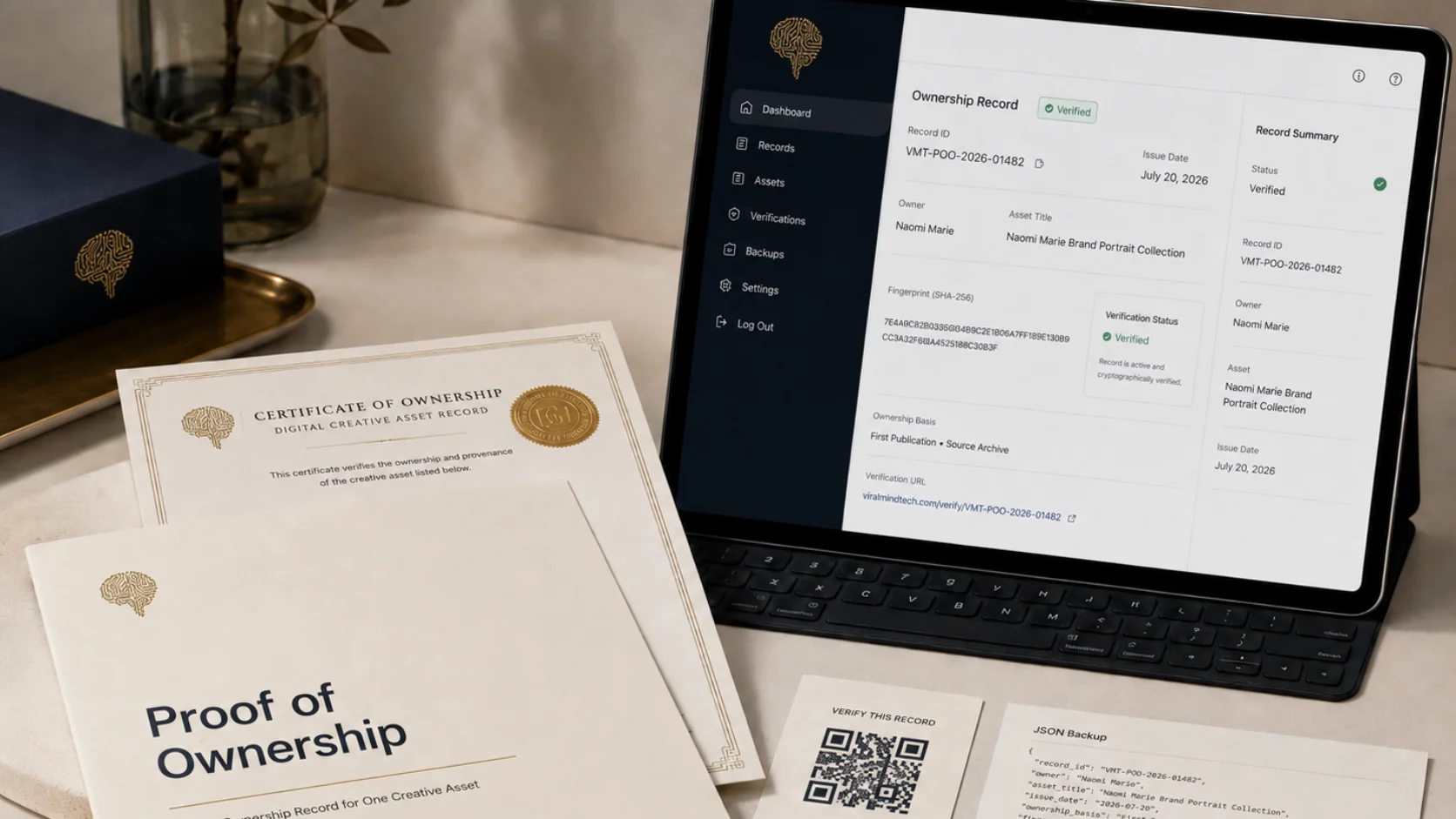
This makes a fingerprint useful for connecting a certificate or registry record to one exact file without placing the creative file on a public verification page. The Proof of Ownership workflow calculates the fingerprint locally in the browser, so the original file does not need to be uploaded for the hash to be created.
The fingerprint has a defined limit. It can show that a later file matches the file connected to the record. It does not identify the creator, establish the ownership basis, or prove that the registrant held the rights at the time of registration.
File Identity, Not Legal Title
A fingerprint strengthens file traceability. Authorship and ownership still depend on the wider record.
The finished record should keep the evidence connected
A usable ownership record should bring the core facts into one system rather than leave them spread across an inbox, cloud drive, social profile, and contract folder.
The Proof of Ownership Standard connects one defined asset to:
- A PDF ownership certificate.
- A unique server-issued registry ID.
- An issue timestamp.
- The local SHA-256 file fingerprint.
- A public verification page and readable verification URL.
- A scannable QR code and downloadable QR image.
- A structured JSON backup of the issued record.
- Protected access for record restoration during an active plan.
These outputs make the record easier to store, verify, and include in a response. They do not replace the source files, agreements, publication history, or other material that supports the claim.
Response readiness matters before a claim arrives
Evidence has more practical value when it can be found and assembled without several days of searching. A response file should identify the asset and point to the records that support each part of the claim.
Keep an evidence index with:
- The ownership record and registry ID.
- The exact fingerprinted file.
- The earliest source material and dated versions.
- The ownership or assignment agreement.
- Contributor and licensing records.
- The first-publication record.
- Relevant invoices, correspondence, and delivery records.
- A short chronology written in plain language.
The chronology should distinguish facts from assumptions. It should state what was created, who was involved, which rights were transferred, where the work first appeared, and what use is being challenged.
A private record has clear limits
Proof of Ownership documents a self-declared claim and supporting metadata. It is not formal copyright registration, a government filing, legal advice, legal representation, or a court ruling.
The record does not:
- Guarantee that a platform, client, authority, or court will accept the claim.
- Grant ownership, licenses, or permissions the registrant does not hold.
- Resolve credible conflicting evidence by itself.
- Replace contracts, source files, drafts, publication records, or formal registrations.
- Turn a false or inaccurate declaration into a valid ownership right.
Its value comes from consistent documentation: one defined asset, one stated ownership basis, one fingerprinted file, one dated registry record, and the supporting evidence kept around it.
Ownership documentation checklist
- The asset is named and clearly defined.
- The claimed owner is identified.
- The original creation date has supporting records.
- Source files and meaningful versions are retained.
- The ownership basis is stated and documented.
- Contributors and client rights are recorded.
- First-publication details are saved.
- Current licensing status is clear.
- The exact original file has a fingerprint.
- The registry ID and issue timestamp are stored.
- Certificate, JSON backup, and QR output are downloaded.
- A response file can be assembled without reconstructing the history.
Documentation works best as part of the creation and publishing process. Waiting for a dispute leaves gaps that a later certificate cannot repair.
Common Questions
Questions about ownership documentation
Does a private ownership record replace copyright registration?
No. It can organize a declared claim, asset metadata, dates, a file fingerprint, and supporting evidence. It does not replace formal copyright, trademark, or other government registration.
What does a SHA-256 fingerprint prove?
It identifies the exact file used to create the fingerprint and can confirm whether another file matches it. It does not identify the creator or establish ownership by itself.
Can I document an older asset?
Yes. Record the original creation date separately from the later issue timestamp. Keep earlier drafts, source files, messages, publication records, contracts, and other material that supports the historical date.